






Last updated on November 25th, 2025 at 02:00 am
Yes — you can go to jail for unpaid or unfiled taxes, but only if the government proves you acted with criminal intent. In other words, falling behind on taxes isn’t a crime by itself. However, if the IRS or a state tax agency determines that you willfully avoided paying or filing, you could face criminal tax charges for tax evasion or tax fraud.
Every year, thousands of taxpayers fall behind without ever facing prosecution. Most are subject to civil penalties, not prison. But when the government can show evidence of intentional misconduct—such as falsifying income, hiding assets, or ignoring multiple IRS notices—the case can move from a civil debt issue to a federal crime.
In 2025, with enhanced IRS funding and stricter enforcement priorities, criminal investigations into tax evasion, unfiled returns, and back taxes are on the rise. Understanding when tax debt becomes criminal, and what you can do before it reaches that point, is essential to protecting your rights and avoiding prosecution.
The IRS is Forgiving Millions Each Day. You Could Be Next.
Key Takeaways
- Jail for unpaid taxes is rare but possible when the IRS or state proves willful tax evasion or fraud.
- Tax evasion and tax fraud are criminal offenses under 26 U.S.C. §7201, carrying up to five years in prison.
- Failure to pay taxes is usually a civil issue unless there is intent to deceive or conceal income.
- The IRS Criminal Investigation Division prosecutes less than 2% of cases, but convictions exceed 90%.
- State, business, and payroll tax violations can lead to jail if nonpayment is deliberate.
- Filing returns, even without payment, reduces legal risk and shows good faith.
Early action with a qualified tax attorney can prevent criminal prosecution and protect your rights.
Which Tax Crimes Can Actually Land You in Jail?
While unpaid taxes alone rarely result in jail, certain actions can transform a tax debt into a criminal tax case. The key factor the IRS and state tax authorities look for is intent — whether you willfully attempted to evade or defraud the government.
Under 26 U.S.C. § 7201, tax evasion is a felony that can lead to up to five years in prison, along with substantial fines and prosecution costs.
In simple terms, you can go to jail for tax evasion, not for being broke. Failing to pay because you lack the money is treated as a civil violation; intentionally concealing income, falsifying records, or ignoring tax obligations is viewed as criminal conduct.
Types of Tax Crimes
When taxpayers face criminal prosecution, nearly every case falls into one of two categories: tax evasion or tax fraud. While both are serious offenses, the legal standards, penalties, and intent requirements differ slightly. Understanding how the government distinguishes between the two can help you recognize what’s at stake—and how to avoid crossing that line.
Tax Evasion
Tax evasion is the deliberate act of avoiding paying taxes that are legally owed. It involves taking steps to conceal income, falsify financial information, or mislead the IRS. Under 26 U.S.C. § 7201, tax evasion is classified as a felony offense, carrying some of the harshest penalties in federal tax law.
Common examples of tax evasion include:
- Underreporting or omitting income from tax returns
- Falsifying business expenses or deductions
- Hiding income in offshore or unreported accounts
- Using false Social Security numbers or shell companies to disguise earnings
Tax evasion penalties can include:
- Up to five years in federal prison
- Fines of up to $250,000 for individuals or $500,000 for corporations
- Payment of restitution and prosecution costs
The IRS Criminal Investigation Division (CID) investigates thousands of tax evasion cases each year. In 2025, CID has specifically increased enforcement against high-income individuals and small businesses engaging in concealment schemes or long-term nonpayment.
Tax Fraud
Tax fraud is broader and includes any intentional deception or misrepresentation made on a tax return or to the IRS. While evasion focuses on avoiding payment, fraud often involves false statements, forged documents, or misleading submissions to obtain an illegal tax benefit.
Examples of tax fraud include:
- Falsifying income or deductions on a return
- Claiming dependents who do not exist
- Failing to report all sources of income
- Filing false refund claims
- Manipulating payroll or business records
Tax fraud penalties depend on the severity of the violation. According to IRS guidelines, sentencing for tax fraud can include:
- Up to three years in prison for filing a false return
- Fines up to $250,000 for individuals
- Civil penalties equal to 75% of the unpaid tax in addition to restitution
Tax Evasion vs. Tax Fraud: Key Difference
The main difference between evasion and fraud is how the intent to deceive is proven:
- Tax evasion involves actions taken to avoid payment of taxes already owed.
Tax fraud involves lying or falsifying information to reduce or eliminate a tax obligation.
Tax Evasion Consequences and Sentencing
The consequences of tax evasion or tax fraud depend on the severity of the violation, the amount of unpaid tax, and most importantly proof of willful intent. The IRS and Department of Justice treat intentional deception as a federal crime, meaning a conviction can result in both financial penalties and prison time.
IRS Criminal Investigation (CID) and Case Development
Criminal tax cases typically begin when the IRS Criminal Investigation Division (CID) identifies evidence of fraud during an audit or through third-party information. CID agents analyze tax returns, bank statements, and financial records to determine whether a taxpayer willfully attempted to evade tax rather than made an honest mistake.
If CID agents believe criminal conduct occurred, they refer the case to the Department of Justice’s Tax Division, which decides whether to prosecute. Only a small fraction of audits—less than 2%—ever become criminal cases, but once a prosecution begins, the conviction rate exceeds 90%, making early legal intervention essential.
From Audit to Prosecution: How Cases Escalate
- Audit or Review: The IRS detects inconsistencies or unreported income.
- Referral to CID: Criminal investigators take over to establish intent.
- DOJ Tax Division Review: Federal prosecutors determine if evidence supports charges.
- Indictment and Trial: Formal criminal charges are filed.
- Sentencing: If convicted, the court imposes fines, restitution, and possible prison terms.
The entire process can take months or even years, but once the DOJ accepts a case, prosecution is aggressive and conviction outcomes are likely.
Prison Time and Penalties for Tax Crimes
Offense / Statute | Maximum Prison Term | Fines & Additional Consequences |
Tax Evasion (26 U.S.C. § 7201) | Up to 5 years | Up to $250,000 for individuals or $500,000 for corporations, plus restitution and prosecution costs. |
Filing a False Return (26 U.S.C. § 7206) | Up to 3 years | Fines up to $250,000 and potential civil fraud penalties. |
Failure to File a Tax Return (26 U.S.C. § 7203) | Up to 1 year per unfiled return | Fines up to $25,000 per offense, plus accumulated penalties and interest. |
Aiding or Assisting Tax Fraud (26 U.S.C. § 7202) | Up to 5 years | Fines, restitution, and potential loss of professional licenses. |
Civil vs. Criminal Tax Penalties
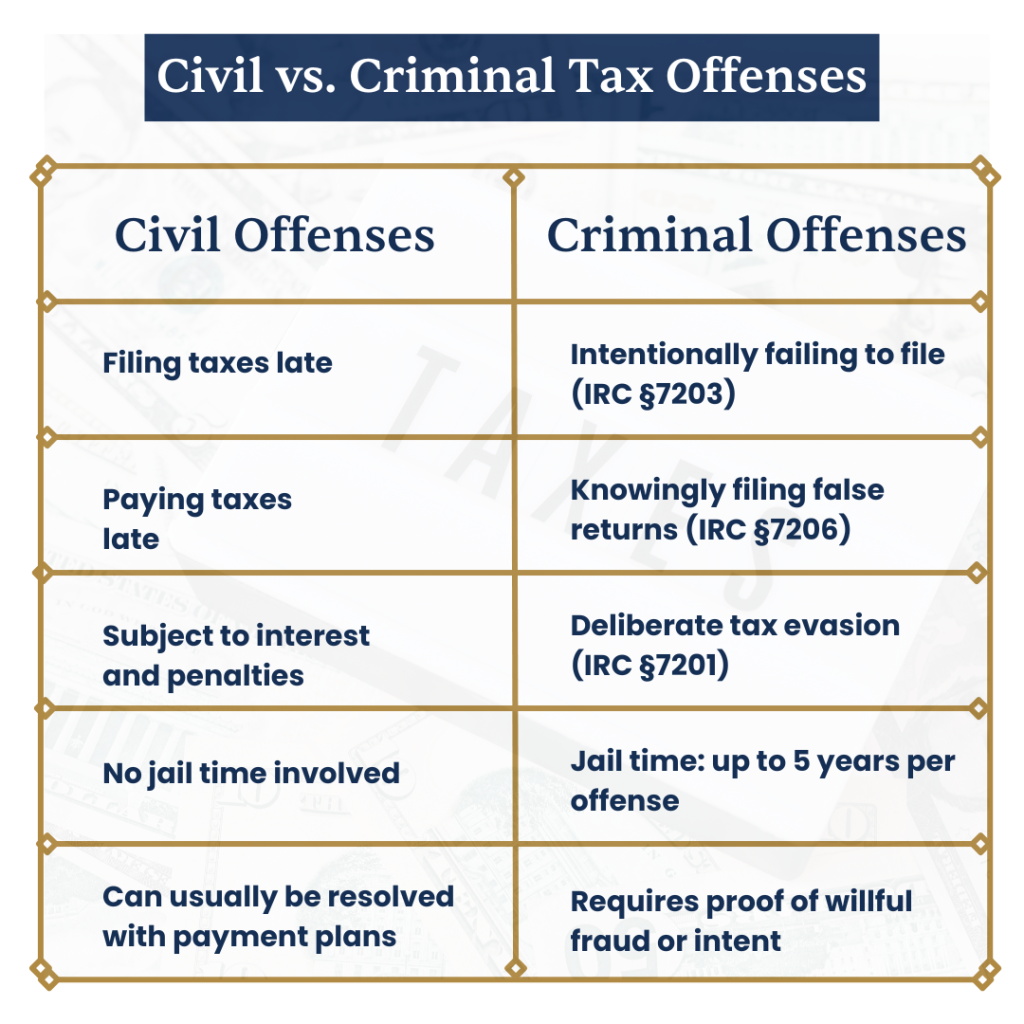
Not every tax mistake results in jail. The IRS uses civil penalties in most cases, especially when errors seem unintentional. Jail becomes a risk only when there's clear evidence of fraud or willful misconduct.
Here's how the agency generally responds:
- Failure to Pay (IRC §6651) Taxes is treated as a civil issue. The IRS applies late-payment penalties and interest until the debt is resolved. Jail is not imposed unless combined with evasion or fraud.
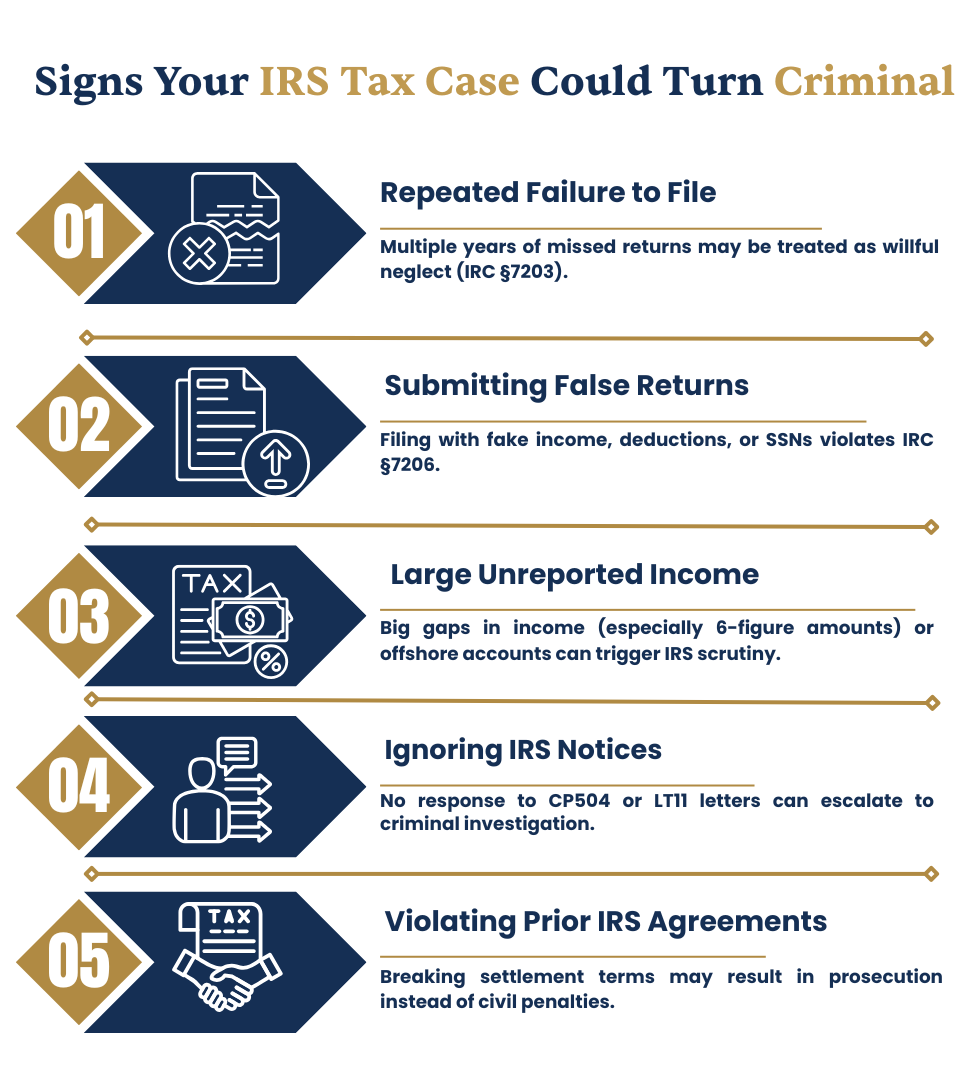
- Failure to File (IRC §7203) Returns can be civil or criminal. If late filing is seen as deliberate, the IRS may escalate it to a criminal case, especially if returns are missing for multiple years.
- Submitting False Returns is always a criminal matter. The IRS doesn’t need to prove financial gain, only that you knowingly reported false information.
Tax Evasion involves any deliberate act to avoid taxes and is considered a felony. If proven, the IRS can impose both criminal penalties and civil recovery of back taxes.
People Who Have Gone to Jail for Tax Fraud
When willful fraud or tax evasion is involved, the IRS does not hesitate to pursue criminal charges, often resulting in tax fraud jail time and significant fines. Below are notable individuals who have faced tax fraud punishment, including sentencing for tax fraud and prison terms.
- Wesley Snipes, known for his roles in films like Blade, was indicted in 2006 on tax fraud charges for allegedly failing to file federal income tax returns and presenting a fraudulent claim for payment to the IRS. He was sentenced to three years in federal prison for willful failure to file tax returns.
- Mike Sorrentino, famous from the reality TV show Jersey Shore, was sentenced in 2018 to eight months in prison for tax evasion. He admitted to concealing income to avoid paying taxes, leading to his tax fraud punishment.
- Ja Rule (Jeffrey Atkins), a Grammy-nominated rapper, was sentenced to 28 months in federal prison in 2011 for failing to file tax returns on over $3 million in income. His sentencing for tax fraud also included substantial restitution.
- Daryl Strawberry, a former Major League Baseball star, was sentenced in 1995 to three years probation, including six months of home confinement, for tax evasion. He failed to report significant income from autograph signings and other sources.
- Joe Francis, founder of the Girls Gone Wild franchise, was sentenced to 301 days already served and one year of probation in 2009 for filing false tax returns. He was accused of deducting over $20 million in false business expenses to evade taxes.
Are you facing tax fraud penalties or IRS investigations? Call J. David Tax Law at (888) 342-9436 to protect your rights and resolve your tax issues.
Can You Go to Jail for Not Paying State, Business, or Local Taxes?
Yes — you can go to jail for not paying state, federal, or business taxes if your actions show willful intent to avoid payment. The risk varies by tax type, but across the board, the government treats intentional nonpayment as a serious offense.
State and Local Taxes
Failing to pay state taxes, city taxes, council tax, or property taxes can lead to criminal penalties under state law if authorities prove deliberate evasion. Most states can issue liens, license suspensions, and even jail sentences for willful nonpayment, especially when taxpayers ignore repeated notices or falsify information.
Business and Payroll Taxes
Unpaid business taxes, sales tax, or payroll tax can be even more severe. These are often considered “trust fund taxes” — money withheld from employees or collected from customers. If you intentionally fail to remit these funds, you can face felony charges under IRC §7202, punishable by up to five years in prison and heavy fines.
Income Taxes
For individual taxpayers, failing to pay income taxes (your federal or state personal taxes) is usually a civil matter, resulting in penalties and interest. However, when nonpayment becomes deliberate — such as hiding income or ignoring repeated IRS demands — it can escalate into criminal tax evasion.
In short, whether it’s state taxes, sales tax, business taxes, property taxes, city or council tax, income tax, or payroll tax, jail is only possible when the government can prove you willfully avoided payment. Honest mistakes, financial hardship, or temporary inability to pay generally lead to civil penalties, not criminal prosecution.
How to Avoid Jail for Tax Issues
The best way to avoid criminal tax charges is to stay compliant, especially when things get tough. Jail typically becomes a risk only when there’s willful neglect or deception. Here’s how to stay on the right side of the IRS:
1. Always File, Even If You Can’t Pay
Failing to file a return triggers much steeper penalties than not paying. Filing shows good faith, even if you don’t have the money. The IRS offers ways to settle later, but they’re less forgiving when you don’t file at all.
2. Set Up a Payment Plan Using Form 9465
If you owe back taxes, an Installment Agreement can help you avoid collection actions. The IRS allows monthly payments, and once you're in a plan, they typically pause enforcement like levies or garnishments. Applying early shows intent to resolve the debt.
3. Consider an Offer in Compromise (Form 656)
If you truly can’t afford to pay the full balance, an Offer in Compromise (OIC) allows you to settle for less. The IRS reviews your income, assets, and expenses before deciding. Approval is tough but possible, especially if you're in financial hardship.
4. Request Currently Not Collectible (CNC) Status
If you can’t even afford a payment plan, you may qualify for CNC status. This temporarily stops all IRS collection efforts if you prove you can't cover basic living expenses. It doesn't erase the debt, but it protects you from aggressive enforcement.
5. Maintain Records and Respond to Notices
Tax mistakes often start small. Keep thorough documentation of income, deductions, and IRS correspondence. If you receive a notice, respond by the deadline, even if it’s just to ask for more time. Ignoring letters is one of the fastest ways to escalate a civil issue into a criminal one.
Proactivity is your best defense. Whether it’s a missed return or large tax bill, early action can mean the difference between a manageable resolution and serious consequences.
Owe Back Taxes or Unfiled Returns? Talk to a Tax Attorney Now
If you're behind on taxes, under audit, or worried about IRS enforcement don’t wait until it escalates. Jail time for tax issues is rare, but penalties, interest, and asset seizures are real risks when left unresolved.
At J. David Tax Law®, our IRS tax attorneys know how to stop garnishments, negotiate settlements, and shield you from criminal exposure. Whether you’ve received a Final Notice, owe six figures, or haven’t filed in years, we act fast to protect your income and your rights.
We offer free, confidential consultations and serve clients in all 50 states. Call (888) 342-9436 now to schedule your free case review. One call can stop IRS action and give you peace of mind.
Conclusion
While jail for unpaid taxes is uncommon, the IRS and state tax agencies take willful tax evasion, fraud, and repeated non-filing very seriously. Most taxpayers face civil penalties rather than criminal prosecution—but when there is evidence of intent to deceive or conceal income, charges under 26 U.S.C. §7201 can lead to fines, restitution, and prison time.
Frequently Asked Questions
Can You Go to Jail for Not Paying Taxes?
Yes, you can go to jail for not paying taxes if the IRS can prove willful tax evasion or fraud. Simply owing money isn’t a crime, but intentionally concealing income, ignoring IRS notices, or refusing to pay can lead to criminal tax charges under 26 U.S.C. §7201, carrying up to five years in prison.
Can You Go to Jail for Not Filing Taxes?
Failing to file tax returns can result in misdemeanor or felony charges if done willfully. Under 26 U.S.C. §7203, willful failure to file taxes may lead to up to one year in jail per unfiled return, fines, and civil penalties—especially if combined with tax evasion or fraud.
How much do you have to owe the IRS before you go to jail?
There’s no specific dollar amount that automatically sends someone to jail for owing the IRS. Jail becomes possible only when the government can prove willful tax evasion or fraud, not simply an unpaid balance.
What happens if you don't pay taxes?
If you don’t pay your taxes, the IRS first treats it as a civil issue, not a crime. You’ll face penalties, interest, and collection actions such as tax liens, wage garnishments, or bank levies. Over time, the debt grows, and if you intentionally refuse to pay or hide income, the case can escalate into criminal tax evasion, which may result in fines or jail time.
What Is the Jail Time for Tax Evasion?
Under 26 U.S.C. §7201, tax evasion can lead to up to five years in federal prison and fines of up to $250,000 for individuals. While sentences vary, the minimum sentence for tax evasion often depends on the severity of the offense and whether the taxpayer cooperated